The Niagara Story
Once Upon A Time
In the 1920s in the Canadian coalfields, a 'shaker' process separated the lumps of coal by dropping coal onto a conveyor belt where the coal was pressed over a series of screens. There were often breakdowns because the coal was heavy. A new type of screen was invented with a much smoother action - one to the right, one to the left, one to the right and so on. One of the mine foremen had a bad arthritic condition due to working in cold, damp conditions; he discovered that when he leant against the separator machine, his pain was eased and he was soon able to get back to work again. He went to the Wettlaufer Brothers (inventors) and told them about this machine. The brothers could see an opportunity to reproduce the mechanism but in a smaller version, suitable for use by pain sufferers. This all took place in 1931.
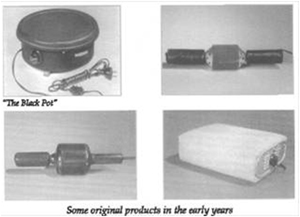
Owen K Murphy, a young imaginative entrepreneur who had served in the medical corps in the war and had seen first-hand the dreadful effects that lack of circulation caused in his wounded friends, said, 'I learned that if we couldn't get girculation in certain parts of an injured GI's body, that man stood a good chance of losing an arm or leg. This bothered me terribly. I wished there was some way to help increase blood movement.' In 1946 Owen Murphy was shown (by Mr Wettlaufer) one of these black boxes at an auction. The Auctioneer claimed that it would increase blood circulation, and that a lack of circulation allowed gangrene to set in. Murphy had often heard doctors say 'if only we could keep our patients' circulation going, we could save their limbs'. Thus, he knew the benefits of improved circulation.
At the same time, Alfred Scaddy, a coal miner in Nova Scotia, had a bad accident. His doctor was at a conference being held in Toronto, and he heard about the black box that increased blood circulation. He knew he had to return to Nova Scotia to amputate both Scaddy's legs. So in desperation, he arranged for the black box to be sent to him. He thought it was worth a try. As it turned out, the constant use of the black box saved both Scaddy's legs. This true story was written up in the January 1977 Canadian edition of the 'Readers Digest'.
Owen Murphy heard this story and flew up to Nova Scotia to verify the information. He met with the Wettlaufer Brothers and arranged for them to make up some black boxes for him, as he had witnessed the potential. However, Owen had difficulty selling the boxes and progress was slow. Then the Wettlaufer Brothers gave Owen an ultimatum to increase his sales. Murphy went to see his friend Frank Paterson, who was a banker, and told him the story. Paterson told him if he had such a great feeling about the product, why didn't he buy the patent? Murphy did exactly that, in October 1949, for the sum of $150,000 - a vast sum of money in those days.
In the first year, the turnover was only $10,000, but by the third year of operation, Murphy had increased this to $4.5 million. He then decided if he were going to expand and produce some literature, he would need research to back up his claims. Thus, Owen Murphy founded the 'Niagara Research Institute', and organised for some local doctors to undertake basic research for him. He then took the results to his advisers and was told that they didn’t mean the type of research Murphy had arranged, as they were only ordinary doctors, and the advisers had meant medical research by specialists, such as University professors and qualified Scientists.
Around this time, Murphy met Dr John R Mote. Dr Mote held a high status in the medical profession for various reasons, including:
- he was a specialist in oriental diseases in China;
- he discovered cortisone;
- he was Chief Medical Adviser to the Allied Nations in WW II, resulting in an OBE;
- he had discovered the birth control pill; and
- he had invented a milk substitute for babies.
Dr Mote was to become the coordinator of the Niagara Medical Research Institute.
Dr William Edmondson was also heavily involved in the Institute as he was an expert in relaxation, specialising in calming patients with mental health disease in order to communicate with them. His research lead to one of Niagara's major claims that the therapy can ease nervous tension.
Dr William Kolossvary of Thiel College was another involved in the Institute. Dr Kolossvary, of the Thiel College, was also involved in the Institute. He was a Physicist who was asked to test the Niagara 'action'. He told Murphy he needed a couple of weeks to sort out the vibrations. It actually took eight months, and in that time he realised he had discovered a new source of 'energy'. He was so excited that he rang Murphy and asked him to come down and see this new energy, now known as 'cyclotherapy'. This action had never been recorded before in the field of physics, and no-one else had it, except him.
Cyclotherapy had a very special motor, with special components, and the rarest, lowest amplitude readings. It was a perfectly unbalanced motor, and it had to be specially constructed and tested. It ran continuously for 900 hours before the underwriters' laboratory gave it their seal of approval. In order to determine the strength of the vibration, acceleration rates needed to be measured. Niagara acceleration rates are very low; approximately 28m2/second. Other techniques of vibration product around 1290m2/second- that is about 50 times greater than Niagara's cycloid vibration. This is what sets cycloid vibration apart from anything else - it is a non-aggressive technique. Where other vibrations can traumatise and cause damage to body tissue, Niagara's low acceleration rates means there can be no tissue damage.
Dr Theodore Bayliss was one arthritic specialist who tested Niagara. He was so excited with the results that in the 1950s he would go to medical conventions to tell as many people as he could about the product and how unique it was.
Dr William Bierman was named 'Outstanding Physician of the Year' in 1955 and he founded the Institute of Physical Medicine. His research involved blood circulation with Niagara, where he injected a radioactive sodium salt solution into a leg before, and after, Niagara treatment. He found circulation was indeed quicker after using Niagara therapy. Thus the claim that Niagara promotes blood circulation when applied.
Niagara was, and still is, involved with Teaching Hospitals, Medical Universities, Research Institutes' and a variety of other Health Clinics around the world.
In the beginning, Niagara manufactured professional treatment tables for use by doctors and hospitals. It was soon recognised, however, that people didn't just have problems when they visited their doctor, or went to hospital. People had health concerns on a day-to-day basis. Niagara researched, and then developed, products that could be easily used in the home, every day.
Owen Murphy had a vision to get Niagara therapy into every home, and this dream is deeply instilled into all those who appreciate the value, benefits, and help that Niagara's therapy brings.
Since the original research was undertaken, Niagara has continued with many ongoing research projects, most of which have been, and still are, being coordinated by Professor Pierre Lievens, M.D. of Brussels University in Belgium. Prof. Lievens is one of the world’s leading experts on electrotherapy, and in recent years has carried out many important studies into Niagara's therapy. He has published his results in medical journals throughout the UK and Europe. He has also spoken of Niagara at a worldwide rheumatology conference held in Sydney, attended by many of Australia's leading specialists in rheumatology.
Niagara's commercial development continued in the States with a network of distributorships, set up in much the same was as they are in Australia today. The company was fast creating a reputation and culture that had never been equaled in the direct-sales industry.
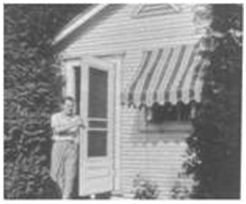
Owen K Murphy outside Niagara Therapy original factory - formerly a chicken coop.
EUROPE, SOUTH AFRICA, AUSTRALASIA
It was in 1961 that a young Irish man called Peter Crealey joined the company as a Consultant in Calgary, Canada. Peter was to play a major part in the development of Niagara throughout the world. Peter cut his teeth selling Niagara door-to-door, as was the way in the 1960s. He was very successful, and after a year or two he applied for, and was granted, the distributorship in Ireland. Back in his homeland again, Peter began Niagara of Ireland in March 1963.
This was the first time that Niagara had been sold outside North America, and in 1965 Peter was asked by the parent company to take over the entire UK operation. He accepted.
From a base in London, Peter went on to open distributorships in Belgium, France, Italy, Greece, Sweden, South Africa, and Australia. The European operation grew rapidly.
Because of Peter's ability to set up successful Niagara operations, he was offered a position with the company's Head Office, as World Sales Manager, in 1972, and given the task of building a worldwide Niagara network.
During the following 10 years, Niagara expanded to many parts of the globe. Peter eventually resigned from his hectic lifestyle, moving to Australia with his wife Sue, to take over the Australian distributorship as well as the South East Asian region as a whole.
Niagara is an independently-owned Australian company who manufactures from their Queensland factory, sourcing the finest and highest quality local and international components, and has distributors world-wide.
The sophisticated software is designed, engineered and manufactured in Australia, with reliability and ease of use in mind; our medical devices are factory-made to the highest International Medical Standards, and are listed on the Australian Register of Therapeutic Goods (ARTG).
Every year, Niagara Therapy undergoes rigorous inspection by the Therapeutic Goods Administration (Medical Devices) in order to maintain registration on the ARTG.
Some examples of current diverse users of Niagara Therapy in Australia include (not limited to):
- 21 hospitals and 12 nursing homes throughout Asia
- University of Sydney (teaching tool)
- Australian Institute of Sport (AIS), Rehabilitation and Recovery Section
- Paralympians
- St George Hospital Physiotherapy Department
- Australian Cricket Team (18 years ongoing)
- Melbourne Storm NRL Club
- Queensland Ballet Troupe
- Leading AFL players
- Olympic athletes
Peter Crealey is now Chairman of Niagara in Australasia.
COMMUNITY / CHARITY INVOLVEMENT - FAIRYLAND CENTRES
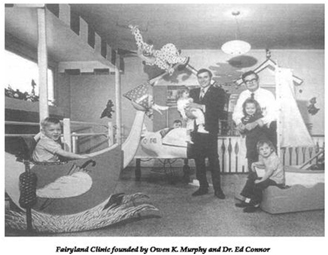
The first Fairyland Centre was established in the United States in 1954. The goal of this clinic was to provide a friendly, fun environment where children with physical and emotional disorders could receive the rehabilitation they so desperately needed, away from the cold and sterile hospital atmosphere. This was a revolutionary concept of mixing therapy and play by building a variety of therapeutic 'toys'. These therapeutic toys are in the form of bulldozers and trains, a "big red chair" and portable equipment, which provide beneficial massage treatment while the children are playing and learning. Owen Murphy’s ingenuity, drive, generosity and compassion lead to the Fairyland concept being duplicated worldwide.
This concept was introduced into Australia by Peter Crealey at the Latrobe Special School at Traralgon, Victoria, in 2008. The next centre was opened at Kuraby Special School in Brisbane, Queensland, in early 2011.
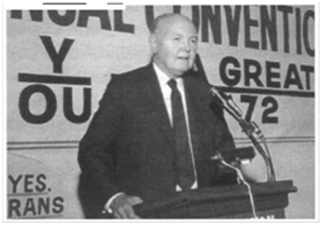
Dr John Mote OBE - first Coordinator of Medical Research addressing the 1971 Niagara Therapy convention at Niagara Falls.
Since Kuraby there have been 6 more such centres launched that are aligned with Special Schools throughout Australia and New Zealand - Bundaberg Special Developmental School (Qld), William Rose Special School and Orange Special Developmental School (NSW), Sir Keith Park Special School (NZ), Durham Road Special School (WA), and Croydon Special Developmental School (VIC). Current centres liaise with each other to discuss programs and help each other moving forward with therapy and teaching programs, supported by the mix of qualified teachers, health therapists, carers and the Niagara Therapy equipment that is registered as medical devices with the Australian Register of Therapeutic Goods (ARTG). Niagara Therapy premises and processes are inspected yearly by the Therapeutic Goods Administration (TGA) in order to ensure compliance and keep registration current on ARTG.
Niagara's Fairyland Centres are primarily funded by internal revenue - fundraising events conducted by our Consultants, Call Centre, Head Office and Manufacturing personnel. The large toys are designed and created by our factory team, mostly outside working hours and on weekends.
Niagara Therapy Fairyland Centres are an integral part of the company culture.
YESTERDAY, TODAY AND TOMORROW
The vision of Owen Murphy is alive and well, due to the efforts of Peter Crealey who has been able to preserve this unique culture that is attributed to Niagara's worldwide success. This culture is reflected in the wonderful institution, first created by Owen Murphy, known as 'The Fairyland Clinic'. The first of these clinics opened in Meadville, Pennsylvania, USA. Murphy transformed an old mansion on Park Avenue into a fantasy-like environment that Dr Ed Connor had always wanted for the many exceptional children in the state who needed his help.
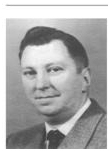
Dr Ed Connor, Co-founder of Niagara Therapy Fairyland Clinic
From his own personal experiences, 'Dr Ed', as he was affectionately known, knew how frightening the cold, sterile atmosphere of any hospital or clinic could be to children. As a result of months of planning, Murphy and Connor created an environment akin to a fairyland – that consisted of relaxing toys big enough to sit in, so the children couldn't tell the difference between play and therapy. Over the years, the Clinic was given a lot of publicity through all forms of the media, highlighting the vivid colour schemes and relaxed environment. It also served as an example for the treatment of handicapped children throughout the world. Besides all this, it is also the place where most of the 'seed' research for Niagara therapy originated. The following extract is from an article written about the Fairyland Clinic:
"On a brisk winter's day in January 1954, several hundred people attended the opening of the Fairyland Clinic in Meadville. A warm, friendly place, designed to delight the hearts and captivate the fancy of little children. No-one who attended the Clinic that day had any idea that later on it would provide the inspiration for a dozen magazine articles, three different network television shows, and hundreds of radio, TV and newspaper feature interviews, as well as a full-length movie called 'Dr Ed', starring Walter Mattheau. But it did”
The atmosphere of the Clinic, and its pioneering in therapy, has been widely copied in other rehabilitation clinics throughout the world.
Much of Niagara culture is captured in the company's creed:
"It is the policy of Niagara Therapy to maintain the highest ethical standards that have won the confidence of people all over the world. To place our counsel and facilities at the disposal of our clients wherever possible. To avoid misrepresentation. To steadfastly improve our products and services. To contribute, through ongoing research and advanced techniques, to the improvement of health and wellbeing of all people"
It is important that claims made by Niagara are backed by solid research, together with Niagara's high ethical standards.
All the research facts provided by Niagara are not exaggerations, and they are not just preliminary findings. They are confirmed results of many studies and research findings published around the world in reputable, prestigious medical and scientific journals, headed up by Scientists, University Professors, Doctors, and associated sectors of the medical fraternity.
That was Niagara's past. Our millions of clients worldwide, along with our devoted staff and consultants are now Niagara's present and future. Getting Niagara into every home was the dream of Owen K Murphy, and this dream is continued every day through dedicated and passionate Niagara Consultants throughout Australia and beyond.